Today marks 31 years since El Cid was listed on the National Register of Historic Places. The date has always been easy to overlook. Nobody re-litigates a home's 1920s pedigree at the closing table. What does get re-litigated, more and more in this market, is a piece of paper: the Certificate of Appropriateness that should exist for every visible exterior change a house has undergone since it was designated.
Sellers in El Cid tend to worry about the wrong thing. They assume a buyer's inspector will flag the age of the wiring, or the clay tile roof, or the original single-hung windows, and that the sale will live or die on those items. In practice, those are known quantities. A 1920s Mediterranean Revival home in a historic district is expected to carry 1920s systems, and buyers who shop this neighborhood already know that. What actually stalls a deal is discovering, mid-contract, that the roof replaced five years ago, or the stucco redone after the last hurricane season, was never run through the city's Historic Preservation Board. The house is fine. The file is not.
What a Buyer's Team Actually Asks For
El Cid sits within West Palm Beach's local historic district system alongside Flamingo Park and Grandview Heights, and any exterior change in these districts, from a roofline to a repainted facade to a window swap, requires a Certificate of Appropriateness before the city will even issue a building permit. Interior remodeling is exempt. That is a genuine relief for sellers who gutted a kitchen or redid bathrooms without ever going near the Historic Preservation Board, because none of that work needed board sign-off in the first place.
Exterior work is a different story. A buyer's title company, lender, or insurer reviewing a historic property now routinely asks not just "was this permitted" but "was this approved for a historic district," and those are two separate questions with two separate paper trails. A permit without a COA on file for a 1920s facade is the kind of gap that used to get waved through during a fast market. In a slower one, it gets caught, and it gets caught by someone whose job is to protect a lender or an insurer, not to be flexible with a seller's timeline.
Staff Sign-Off or a Board Hearing
Not every change goes in front of the full board. The city runs a two-tier review, and knowing which tier a past project fell into matters when you are assembling a seller's disclosure packet.
| Review Level | What Typically Triggers It | Public Notice |
|---|---|---|
| Staff-level | Routine maintenance, exact material replacements, small changes not visible from the street | No hearing required |
| Full board hearing | Additions, major alterations, anything affecting the front facade, demolitions | Yes, scheduled on a public agenda |
The city's own Historic Preservation Board agendas make the board-level category concrete. Recent hearing dockets have included requests for second-story additions with exterior alterations, a pre-construction historic tax exemption application tied to a second-story addition, and a certificate covering demolition of a contributing accessory structure. Those are not hypothetical categories. They are the actual kind of project a board reviews in open session, with a case manager and a commission district assigned, and a seller who did comparable work without going through that process has a gap that a buyer's team can find simply by pulling the public record.
The Two to Four Weeks Nobody Budgets For
Even when a seller did everything correctly, the COA step changes the shape of a renovation timeline in a way that matters retroactively. Standard residential plan review at the city runs 14 to 21 business days. For a property in a historic district, the COA review adds roughly two to four weeks on top of that, and it has to happen first: submitting to Development Services before the Certificate of Appropriateness is in hand is one of the five most common errors plan reviewers flag, alongside missing Notice of Commencement filings, mismatched product approval numbers, incorrect wind-load exposure categories, and unsigned drawings. Incomplete submissions reset the clock entirely.
None of that is a problem for a current listing. It becomes a problem when a seller's documentation shows a permit issued but no corresponding COA approval date, because the sequence itself signals the work may have jumped the process. A clean file shows the COA approval, then the permit, then the final inspection, in that order, with dates that make sense together. A file that only has a permit is the one that generates follow-up questions during due diligence, at the exact point in a transaction when nobody wants new questions.
When the Flood Zone Turns a Renovation Into a Compliance Project
El Cid's eastern edge runs along South Flagler Drive, fronting the Intracoastal, and that stretch sits within an AE flood zone. That geography intersects with the historic district rules in a way sellers rarely see coming: if a renovation's cost exceeds half the home's value and the home sits in a flood zone, the entire structure must be brought up to current flood-compliance standards, not just the portion being renovated. A seller who did a large-scale restoration years ago and stayed under that 50 percent threshold has a straightforward file. One who crossed it without triggering full compliance has a property that may not match what current flood maps and building code require, which is exactly the kind of detail an insurer discovers during underwriting, not during a routine walkthrough.
Flood insurance compounds this. Standard homeowners policies do not cover flood damage, and the city participates in the National Flood Insurance Program's Community Rating System, which extends a 25 percent discount on NFIP premiums to policies within the program. That discount is meaningful to a buyer's monthly carrying cost, but it depends on the property's flood documentation being current and accurate, which loops back to the same paper trail question.
What a Standard Inspection Skips Entirely
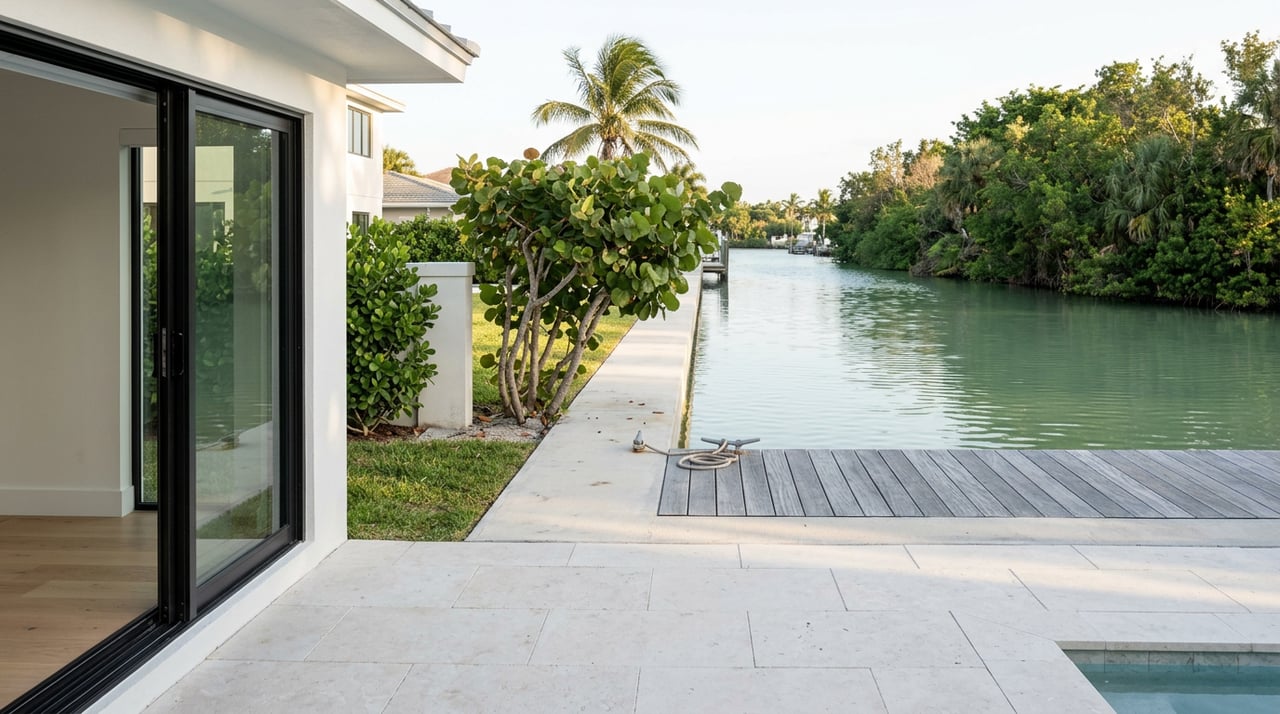
Waterfront lots along South Flagler Drive carry one more blind spot. Most general home inspection standards specifically exclude seawalls and docks, since those are in-water structures outside a general inspector's scope. A seller with Intracoastal frontage who assumes a standard pre-listing inspection covers the seawall is assuming wrong. That requires a separate marine contractor or seawall specialist, and the resulting report becomes part of the same documentation packet as the COA history, because a buyer's team will ask about both.
Why the Paper Trail Matters More Right Now
El Cid's market has thinned out in a way that raises the stakes on all of this. Over the three months ending April 2026, the median sale price in El Cid ran around $3.0 million, down about 7.8 percent from the same period a year earlier, while the median price per square foot fell roughly 15.8 percent year over year. Only five homes sold in April 2026, compared to seven the year before. Days on market did improve slightly year over year, but the underlying picture is a market with fewer transactions and softer per-square-foot pricing, which means each individual deal gets more scrutiny, not less. In a market where offers were competing against each other, a documentation gap might get absorbed. In a market this thin, a buyer with time and options is far more likely to use a paperwork gap as leverage on price, or to walk.
That is the actual thesis worth sitting with. El Cid's age is not a liability. Buyers choose this district because of its architecture, not despite it. The liability is a decade of well-intentioned exterior work that never generated the certificate the city requires, sitting quietly until a title company or an appraiser asks for it during a slower season when nobody is in a hurry to look past a gap.
Frequently Asked Questions
Does interior renovation in El Cid require historic board approval? No. The city's historic preservation review applies to exterior changes visible from the street. Interior remodeling generally proceeds through standard permitting without a Certificate of Appropriateness.
If a past owner did exterior work without a COA, can it be fixed before closing? Sometimes, though it depends on the scope and how long ago the work occurred. The earlier a seller discovers the gap, whether by pulling permit history themselves or through a pre-listing review, the more runway there is to work with the Historic Preservation Board on documentation before a buyer's team finds it independently.
Do I need a separate seawall inspection if I am not planning any dock work? If the property has Intracoastal frontage, yes. Standard home inspection standards exclude seawalls and docks regardless of whether renovation is planned, so a dedicated marine or seawall inspection is the only way to document current condition.
Is the flood insurance discount automatic for El Cid properties? No. The 25 percent discount applies to NFIP policies within the city's Community Rating System participation, and it depends on accurate, current flood documentation for the specific property, not on the neighborhood's designation alone.
A historic district rewards the seller who treats the paperwork as seriously as the architecture. If you are weighing a sale in El Cid and want a clear read on your property's Certificate of Appropriateness history, flood documentation, or what a buyer's underwriting team will actually ask for in this market, Daniel Maya applies the same file-by-file diligence to a listing that an investigative background demands everywhere else. Request a Confidential Market Consultation before you list, not after a buyer's attorney asks the first question.