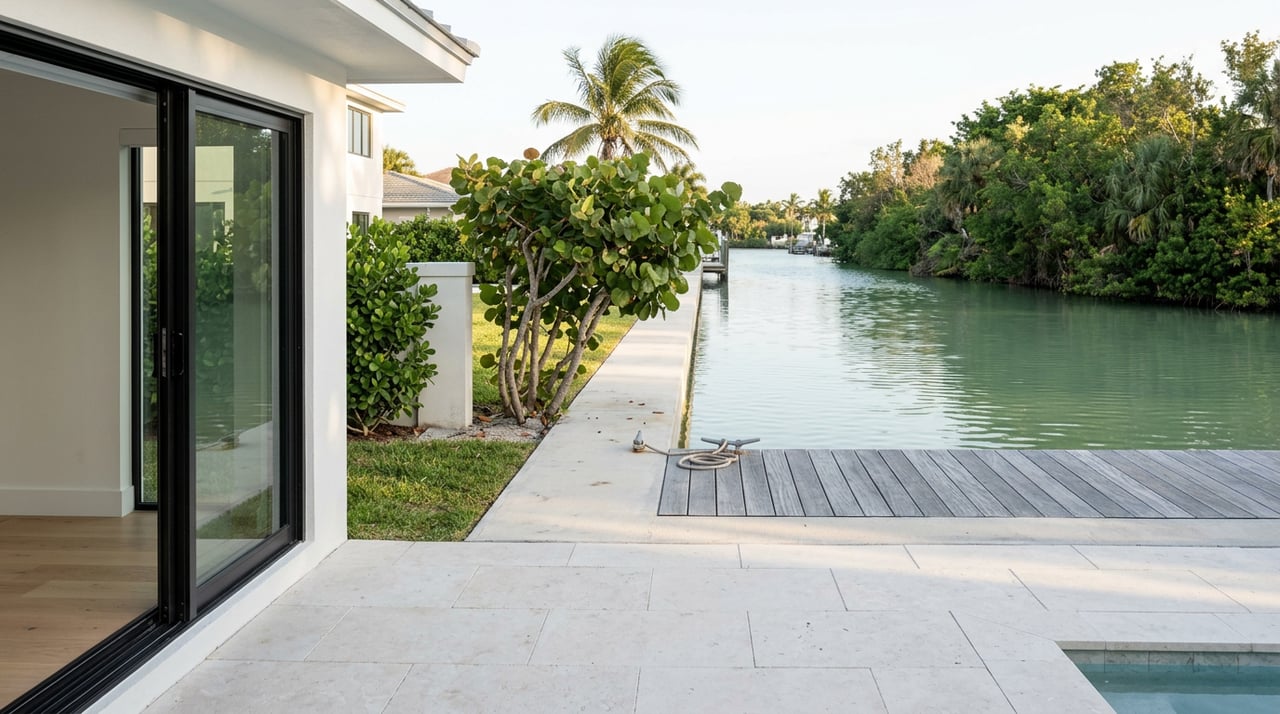
In June, the Palm Beach Town Council approved Murray Logan Construction to lead a $20 million project to replace the seawall running along Midtown Beach. A Palm Beach Civic Association report describes the seawall as a 2,715-foot structure that has held back the ocean since the 1920s and recounts Town Engineer Patricia Strayer's warning to the Shore Protection Board: if the wall fails, the road fails next, then the condominiums behind it. The report says construction is not expected to start until January 2027 and will take up to two years to finish.
That timeline is the part sellers and buyers on the island should sit with. A public agency with its own engineering staff, its own budget cycle, and no closing date to hit still needs roughly seven months between approval and the first pile driven, and up to two years after that to finish a single wall. Private owners rarely have that runway. A seawall problem discovered during a purchase contract does not resolve on a purchase contract's schedule, and that mismatch is the actual friction point in a Palm Beach waterfront sale. Not the home inspection. Not the pool. The wall nobody can see below the waterline until someone asks the right question.
A standard inspection stops at the property line
Florida home inspectors check roofs, HVAC systems, electrical panels, and plumbing. They are not marine engineers, and a seawall, a dock, or a boat lift falls outside the standard scope of a residential inspection. On Intracoastal and canal-front lots in Palm Beach, that means the single most expensive structural system on the property, the one holding the yard and the house pad in place, often goes unexamined unless a buyer specifically requests an engineering assessment.
The signs a marine engineer looks for are not subtle once someone knows to check: a leaning or rotating wall, cracking or spalling concrete, exposed reinforcement, a displaced cap, or erosion and voids forming behind the structure where soil has washed out through failing joints. Any one of those on a property built decades ago, which describes much of the historic housing stock near Midtown and the Estate Section, is worth a professional look before a contract goes hard, not after.
The permit stack that outlasts a closing date
If a seawall does need work, repair or replacement is not a single-agency approval. According to Endless Life Design, a structural project typically requires a Town building permit, a state permit through the Florida Department of Environmental Protection, often a South Florida Water Management District Environmental Resource Permit, and, for anything touching navigable water, federal authorization from the U.S. Army Corps of Engineers. Projects involving dredging or nearby seagrass habitat, which describes a meaningful share of Intracoastal lots, can stretch into months.
Compare that to a typical Florida purchase contract, where due diligence and financing periods are usually measured in weeks. A buyer who discovers a seawall problem during inspection is not looking at a repair that fits inside a standard closing window. They are looking at a permit process that, in the best case, takes longer than the entire transaction. That gap is exactly where deals get renegotiated, delayed, or walked away from, and it is why the smart move is finding out the wall's condition before the contract is signed, not after.
The ordinance that changed what "permitted" means
In 2024, the Town Council adopted Ordinance No. 009-2024, rewriting Chapter 62 of the town code, the section governing marine structures. The update replaced the old reference point for measuring dock and bulkhead specifications, the historic Town of Palm Beach bulkhead line, with the mean high water line instead. It also added specific construction rules for docks on Everglades Island and Ibis Isle, along with new limits on gangway width, terminal platform size, and dock lighting.
For an owner on those islands, or anywhere the old bulkhead line was the reference point in a survey or a decades-old permit, that is not a technicality. A dock or marginal structure that was compliant when it was built may now sit against a different measurement standard entirely. A buyer's attorney reviewing permit history on an older property should be checking which standard the existing structure was approved under, and whether that approval still holds against the current code. A seller who assumes an old permit is still good is assuming something the town changed two years ago.
Why the price range itself is the warning
Seawall work in Palm Beach and the surrounding county runs from roughly $2,000 for sealing a hairline crack up to $80,000 or more for a full structural replacement, according to marine contractors working the local market. That is not a narrow band. It is the difference between a line item and a five-figure renegotiation, and the only way to know which end of the range a specific property falls on is a physical inspection by someone qualified to read tieback condition and cap integrity, not a listing description that says the seawall is "in good shape."
Sellers who have not had that inspection done are, in effect, listing a structural unknown. Buyers who skip it are underwriting the same unknown, just from the other side.
The paper trail matters as much as the concrete
According to JKT Marine, Florida disclosure law requires sellers to disclose unpermitted work, and marine construction is no exception. A seawall patch, a dock extension, or a lift installation done without a permit years ago does not disappear from the property's history just because nobody asked about it at the time. Buyers' attorneys and inspectors routinely pull permit records during due diligence on waterfront property, precisely because unpermitted marine work creates both a disclosure problem at the point of sale and a potential insurance complication down the line.
That is the version of due diligence I bring to every Palm Beach waterfront transaction. Before a client makes an offer, or accepts one, I want to see the permit history on the seawall and dock, not just the survey and the appraisal. An investigative background makes that instinct automatic. A gap in the paper trail on a marine structure is worth the same scrutiny as a gap in a title chain, because it can stall a closing just as effectively.
What this means if you are buying or selling on the water
The town's own Midtown project is a useful reality check, not a scare story. A century-old public wall reached the point where replacement was cheaper than continued patching, and the same math applies to private walls of similar age along the Intracoastal and the canals feeding it. Sellers who get ahead of the question, with a current engineering report and a clean permit file, remove the single biggest unknown a buyer's attorney will look for. Buyers who ask for that documentation before writing an offer protect themselves from inheriting a permit timeline that runs longer than their mortgage rate lock.
Neither side benefits from finding out during the option period.
Frequently Asked Questions
Does a standard home inspection cover the seawall or dock? No. Florida home inspections focus on the structure, roof, and major systems. Marine structures require a separate assessment from an engineer or licensed marine contractor.
What should I ask for before making an offer on a waterfront estate in Palm Beach? Request the permit history for the seawall and any dock or lift, along with a recent engineering report if one exists. If neither is available, factor in the cost and time of getting one before closing.
Is there a faster time of year to get seawall or dock permits approved? Owners often target late fall or early spring to avoid peak hurricane season and turtle nesting season, and to work around any manatee protection windows written into state and federal permits. Even in that window, plan for months, not weeks.
If you are weighing a purchase or a sale on Palm Beach's waterfront, the seawall and the paperwork behind it deserve the same scrutiny as the title itself. Daniel Maya applies that same investigative standard to every transaction. Request a Confidential Market Consultation to get a clear picture of what you are actually buying, or selling, before you sign.
This article is general information, not legal, tax or financial advice. Consult a qualified professional about your situation.